
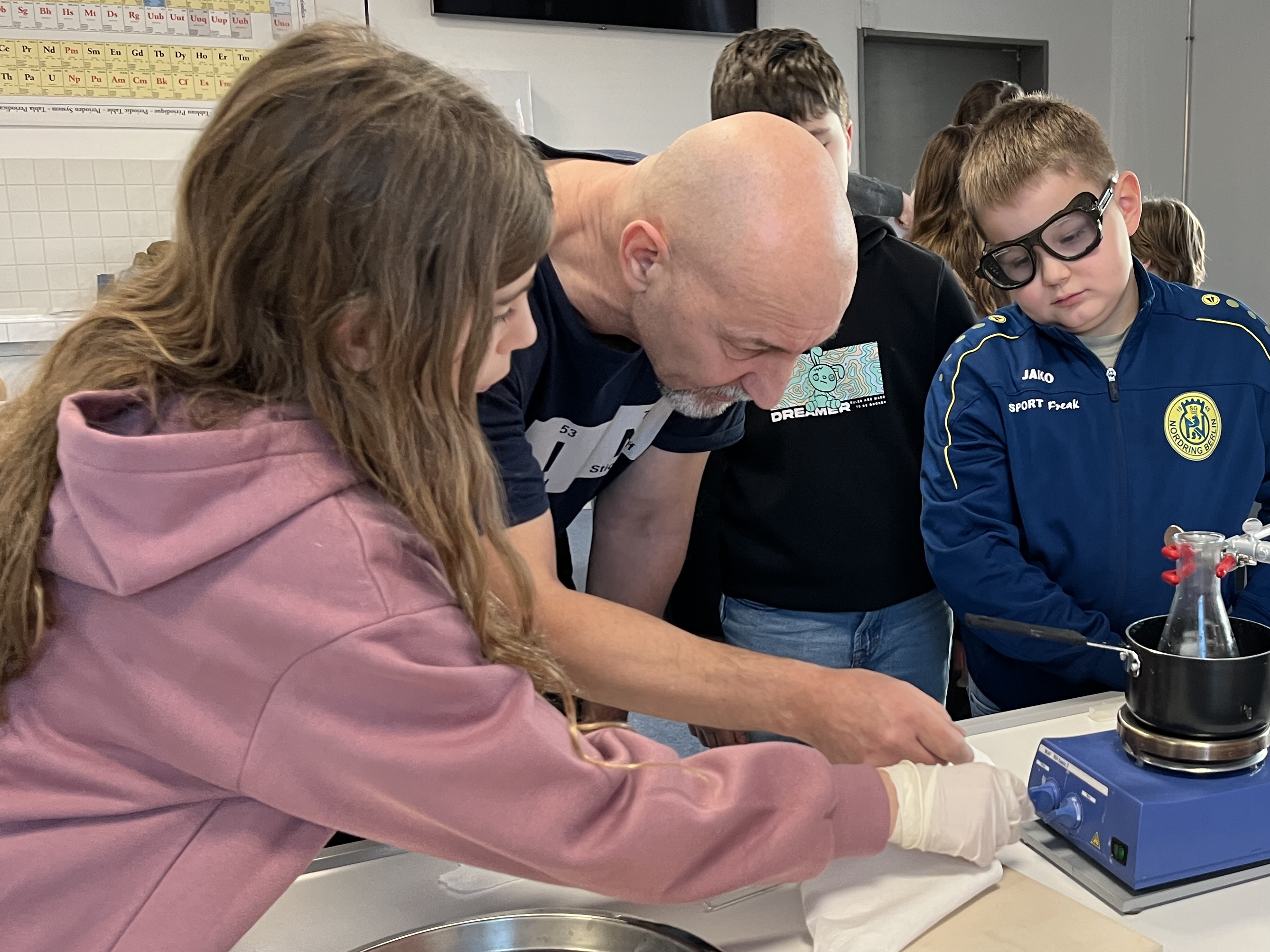
Students Explore Sustainable Alternatives to Plastic
How can we protect our environment more effectively – and what role can our school play in this? The club "Our Happy Future", part of the Erasmus+ project of the Klax School and also active on the digital platform TwinSpace, is dedicated to exploring these questions. Together with their learning guides, the students are researching and practically testing sustainable alternatives to conventional plastic.
How can we better protect our environment – and what role can our school play in this?
Inspiration in Tenerife
The starting point for the project was a trip to Tenerife. There, the students became especially aware of how heavily our environment is affected by plastic and microplastics. Within the group, they examined in detail the impact of microplastics on animals, plants and humans.
Soon the idea for their own project emerged: a “plastic-free school.” As part of their research, the students collected ideas for sustainable and environmentally friendly materials that could replace plastic. During this process, an unexpected question arose: could peanut shells perhaps be used as an alternative?
From Idea to Experiment
The project ideas were presented to the school leadership, who showed great interest. To examine the scientific feasibility, the students discussed their plans with the chemistry teacher, Mr Wolf. Together they considered which natural materials might be suitable for experiments.
They eventually chose chestnuts, because they contain starch that can be used to produce bioplastics, and peanut shells, because they consist largely of cellulose, an important structural substance in plants.
During the summer and autumn holidays, the students collected the materials and prepared them for experiments by drying them.
First Experiments in the Chemistry Lab
In the chemistry laboratory, the students first learned important safety rules and were given an introduction to the chemistry preparation room.
They then examined the materials more closely and discovered:
- Chestnuts contain large amounts of starch, which can serve as the basis for a bioplastic.
- Peanut shells contain cellulose, which gives the material stability.
- Plastics are easily moulded, but they place a long-term burden on the environment.
The aim of the project is therefore to produce a biodegradable plastic from natural waste materials.
Producing the First Bioplastic
In further experiments, the extracted starch was processed. The students worked in groups and produced different mixtures:
1. Starch and water
2. Starch, water and glycerine
3. Starch, water, glycerine and acetic acid
The mixtures were carefully heated in a water bath until they had completely dissolved. They were then poured onto baking parchment and left to dry.
When the samples were examined, it became clear that:
- The first sample was very brittle and broke easily.
- The samples containing glycerine were much more flexible, but still not stable enough.
Further Development of the Material
To improve stability, finely sieved peanut shell powder was added to the mixture. The shells had previously been crushed and sifted using two sieves with different mesh sizes.
The result: the new plastic was significantly more flexible and less brittle, but still developed small cracks during drying. Therefore, in a further experiment the ratios of the ingredients were adjusted in order to improve the material further.
The Next Steps in the Project
The current sample is now drying and will be examined more closely at the next meeting. In the long term, the group hopes to find out...
... how stable the developed bioplastic is,
... how its composition can be further optimised, and
... whether practical objects can be produced from it.
The project is an impressive example of how students can work scientifically, carry out experiments and collaboratively develop solutions to environmental problems. The “Our Happy Future” group continues to work towards turning the vision of a more sustainable, less plastic-dependent future into reality.